Next-Generation Teams
Executive Summary
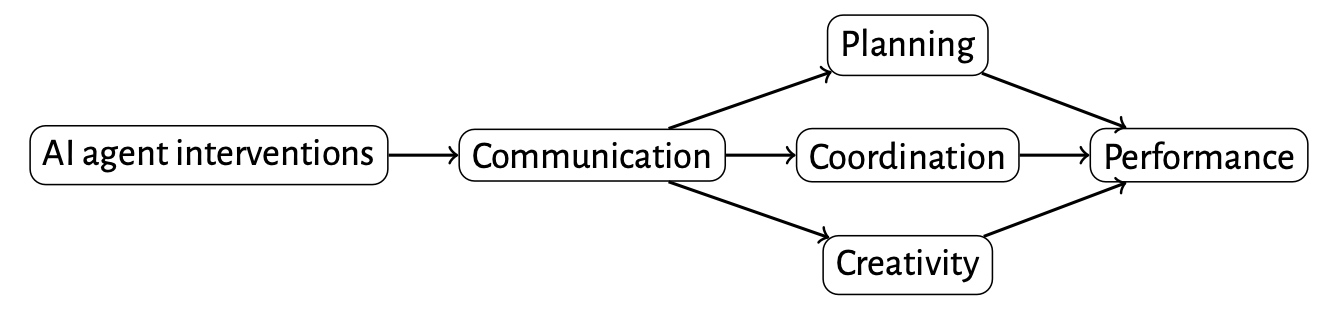
Good teamwork enables teams to perform beyond the sum of their parts. The next generation of teams will be comprised of humans and autonomous agents collaboratively working towards shared goals. With this in mind, it is appropriate to ask the questions (i) what are the key processes that govern teamwork in hybrid human-autonomy teams? and (ii) what capabilities should an autonomous agent have in order to be an effective teammate to its human partners? We propose to explore these questions by conducting experiments to answer a set of hypotheses about structured communication protocols, AI agent interventions to correct deviations from those protocols, and their effects on team performance, coordination, creativity, and plan recognition (see Figure 1). In addition to collecting new data, we will leverage existing data from DARPA’s ASIST program.
Figure 1: Relationships to be explored in this project.
We organize our work around the following fundamental research efforts:
- Detecting communication breakdowns We propose to develop algorithms for detecting communication breakdowns in teams and evaluate them in new experiments involving human-autonomy teaming. For concreteness, we will focus on detecting deviations from closed-loop communication (CLC), but strive to design systems that can generalize to other structured communication protocols.
- Modeling team coordination Coordination is at the heart of good teamwork, but addressing coordination computationally is challenging. We will leverage our ongoing work on coordina- tion, which we model as shared latent constructs that explain and predict interactions between components of a dynamical system, and study the relationship between CLC, coordination, and team performance.
- Plan recognition Team plans can change over time in response to unexpected events. In order for an autonomous agent to serve as an effective teammate, it must have some conception of the plan being followed by the team, and update that representation as the mission unfolds. We will develop algorithms for team plan recognition guided by natural language understanding and study the effect of CLC on the performance of our plan recognition algorithms.
- Understanding team creativity We hypothesize that effective teams will display creativity in their problem-solving approaches in the face of perturbations. We will develop models for detecting creativity at both the individual and team levels based on physiological data and linguistic features of team dialog, and study the relationship between CLC, creativity, and team performance.
Impact: The proposed work will significantly advance our understanding of key processes that govern team effectiveness. Additionally, we will develop open-source software systems and share our data with the public in order to advance the state of the art in human-machine teaming research.
Publications
- Enhancing Interpretability in Deep Reinforcement Learning through Semantic Clustering, The Thirty-ninth Annual Conference on Neural Information Processing Systems (NeurIPS 2025). Liang Zhang, Justin Lieffers, and Adarsh Pyarelal. URL: https://openreview.net/forum?id=YTk1kATzO
- MultiCAT: Multimodal Communication Annotations for Teams, Findings of the Association for Computational Linguistics: NAACL 2025. Adarsh Pyarelal, John M Culnan, Ayesha Qamar, Meghavarshini Krishnaswamy, Yuwei Wang, Cheonkam Jeong, Chen Chen, Md Messal Monem Miah, Shahriar Hormozi, Jonathan Tong, and Ruihong Huang. URL: https://aclanthology.org/2025.findings-naacl.61/
- Probabilistic Modeling of Interpersonal Coordination Processes, Forty-first International Conference on Machine Learning (ICML 2024). Paulo Soares, Adarsh Pyarelal, Meghavarshini Krishnaswamy, Emily Butler, and Kobus Barnard URL: https://openreview.net/forum?id=4zOZ0yKhm6
- Deep Reinforcement Learning with Vector Quantized Encoding, Workshop on Interpretable Policies in Reinforcement Learning @RLC-2024. Liang Zhang, Justin Lieffers, Pavithra Shivanna, and Adarsh Pyarelal. URL: https://openreview.net/forum?id=OyHqrdWADY